Tunnel Architecture
Overview
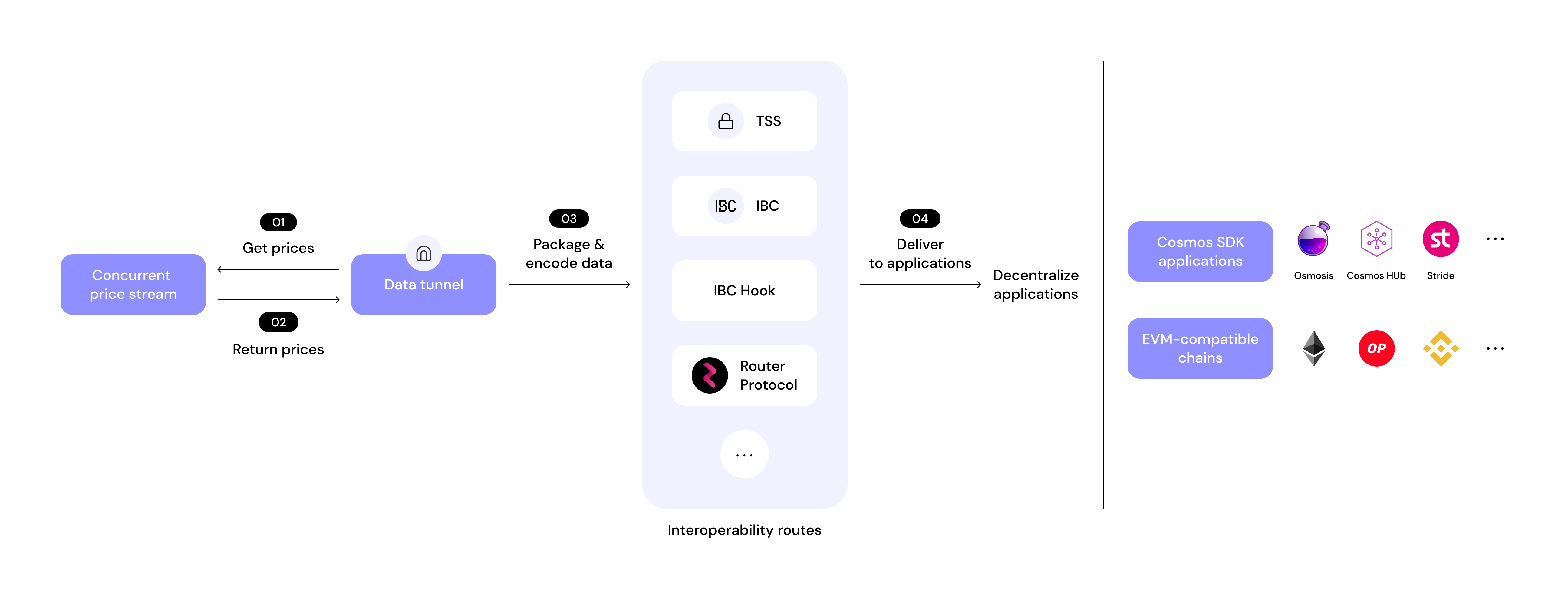
The Data Tunnel serves as a bridge for relaying price data from a concurrent price stream to decentralized applications. It ensures seamless interoperability between various blockchain networks, including Cosmos SDK applications, L1/L2+ EVM contracts, and non-EVM contracts.
Components
1. Concurrent Price Stream
The Concurrent Price Stream is responsible for obtaining real-time pricing data from validators. The stream continuously aggregates price data from multiple trusted validators, ensuring that the Data Tunnel always has access to high-quality and reliable price feeds.
2. Data Tunnel
The Data Tunnel serves as the main process for producing tunnel packets data. It is responsible for:
- Collecting price information from the Concurrent Price Stream
- Producing packets from the tunnel based on interval and the price deviation triggering condition
- Formatting and packaging data into packets based on tunnel route
- Sending structured packets into the Data Tunnel Routes
3. Data Tunnel Routes
The Data Tunnel Routes consist of multiple interoperability mechanisms that facilitate secure and efficient data transmission to send tunnel packets to decentralized applications. These mechanisms include:
- TSS (Threshold Signature Scheme): Ensures cryptographic security for transactions to send it to decentralized applications.
- IBC (Inter-Blockchain Communication Protocol): Provides communication between different Cosmos-based blockchains.
- IBC Hook: Extends IBC functionalities, allowing customized interactions with WASM contracts on Cosmos-based blockchains.
- Router Protocol: First blockchain interoperability platform that supports Band Data Tunnel.
- Other Interoperability Protocols: Additional methods that enhance cross-chain compatibility in the future.
4. Decentralized Applications
Once the data is processed and routed, it is relayed to various decentralized applications, including:
- Cosmos SDK Applications: Applications built on Cosmos that rely on accurate price feeds.
- L1/L2+ EVM Contracts: Smart contracts deployed on Ethereum and other EVM-compatible networks.
- Non-EVM Contracts: Contracts on blockchains that do not use the Ethereum Virtual Machine.
Data Flow Summary
- Price Data Retrieval: The Concurrent Price Stream fetches price information.
- Processing: The Data Tunnel processes and formats price data into structured packets.
- Routing: The Data Tunnel Routes use interoperability mechanisms based on the tunnel creator's choice to relay data securely.
- Delivery: The processed data is sent to decentralized applications for execution.